

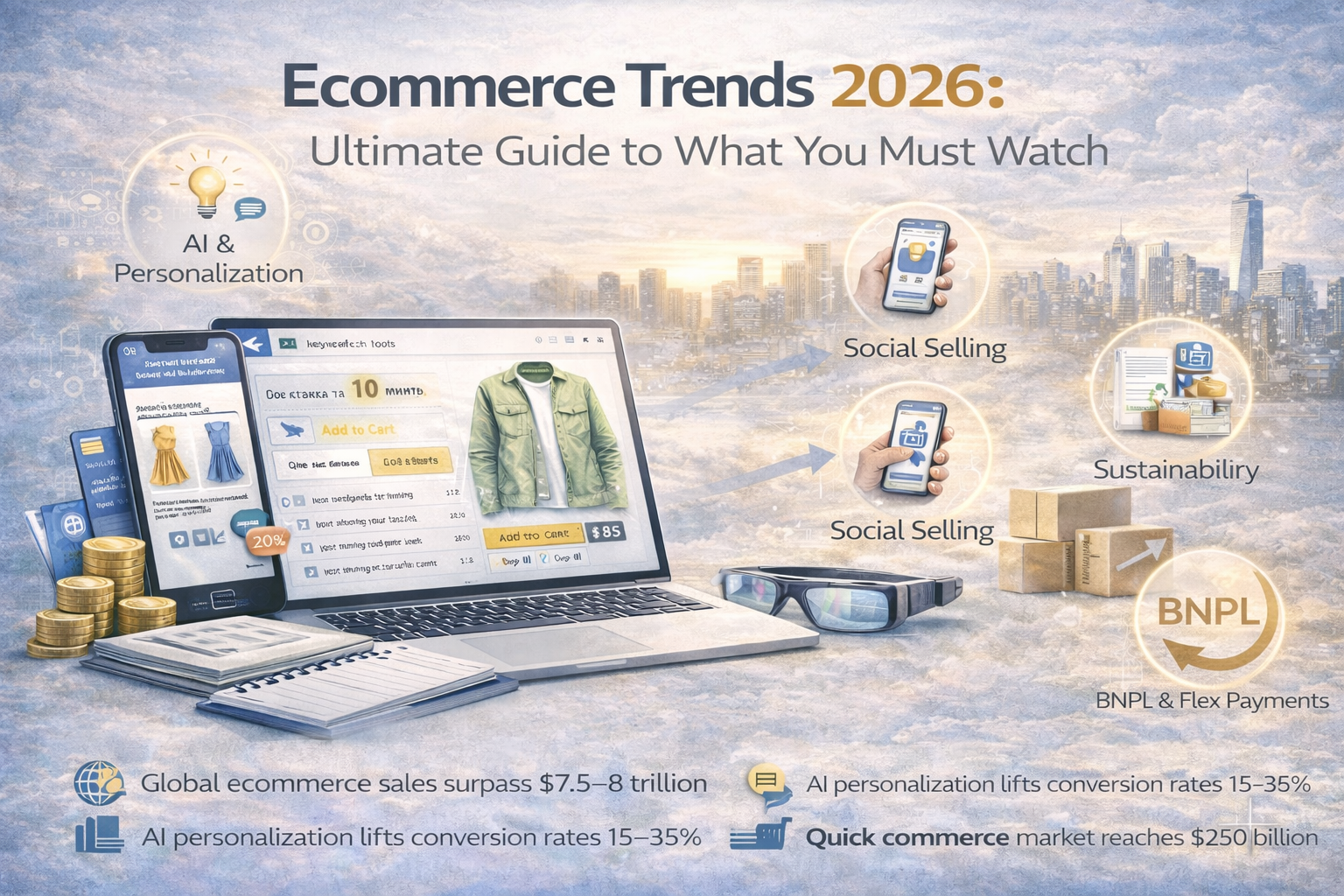
Ecommerce Trends 2026: Ultimate Guide to What You Must Watch
Ecommerce trends 2026 are set to redefine online shopping more dramatically than any year since the pandemic boom.
Global ecommerce sales are forecast to exceed $7.5–8 trillion in 2026 (Statista, eMarketer, Insider Intelligence mid-2026 projections), fueled by explosive growth in emerging markets, AI-driven hyper-personalization, ultra-fast delivery expectations, social commerce dominance, sustainability pressure, and revolutionary checkout experiences (BNPL, voice, one-tap).
Whether you’re running a Shopify store, selling on Amazon, operating WooCommerce, managing a marketplace, or launching a new D2C brand, understanding and acting on the top ecommerce trends 2026 will determine whether you capture market share or get left behind.
This ultimate 2026 guide covers every major ecommerce trend you must watch, including:
- Real statistics & forecasts (updated mid-2026)
- Actionable steps for store owners, marketers & developers
- Tools, platforms & tech stack recommendations
- Real-world case studies & early-adopter success stories
- What to implement immediately vs prepare for in 2026–2027
Let’s explore Ecommerce Trends 2026 the future of ecommerce.
1. AI-Powered Hyper-Personalization – The #1 Ecommerce Trend 2026
What’s happening By late 2026, more than 80% of leading ecommerce sites will use AI to personalize not just recommendations, but entire shopping journeys — dynamic pricing, custom landing pages, predictive carts, AI-generated product descriptions/images/videos, voice shopping assistants, and real-time behavior-based offers.
Key statistics 2026
- AI personalization lifts conversion rates by 15–35% (McKinsey, Adobe 2026 reports)
- 93% of consumers prefer brands that recognize them and deliver relevant experiences (Epsilon, Salesforce)
- Amazon’s AI recommendation engine now drives ~38–42% of total sales (internal estimates 2025–2026)
- Personalized experiences increase average order value (AOV) by 20–30% (Dynamic Yield data)
What it looks like in 2026
- Homepages that change layout, banners, and hero products based on past purchases, location, weather, time of day, device
- AI chatbots that understand context, recommend bundles, upsell/cross-sell, and complete checkout without human help
- Predictive carts (“You’ll probably need this next”) and abandoned cart recovery with personalized incentives
- AI-generated product videos, 360° views, and styling suggestions
Tools & platforms leading
- Dynamic Yield, Algolia, Klevu, Bloomreach (AI search & recommendations)
- Clerk.io, Nosto, Emarsys, Certona (full personalization suites)
- Shopify Magic + Klaviyo AI Flows + Gorgias (native + conversational)
Action steps
- Start with product recommendation widgets (easy win)
- Move to full-page personalization (homepage, category, PDP)
- Integrate conversational AI checkout (chatbot → payment)
- Use first-party data (zero-party quizzes, loyalty preferences) to feed AI
Case study Sephora’s Virtual Artist AR + AI recommendations → 30%+ increase in conversion for beauty buyers (2025–2026 data).
2. Quick Commerce & Ultra-Fast Delivery as Table Stakes
What’s happening Quick commerce (10–60 minute delivery) is no longer a differentiator — it’s becoming a baseline expectation in urban and semi-urban areas worldwide.
Key statistics 2026
- Global quick commerce market size: $180–250 billion (RedSeer, Statista, Bain & Company)
- 72% of Gen Z & 61% of Millennials willing to pay extra for <1-hour delivery (Deloitte, McKinsey 2026)
- 45%+ of urban grocery orders now same-hour in major cities (NielsenIQ)
Implications
- Rise of micro-fulfillment centers, dark stores, ghost kitchens
- Same-hour delivery standard for groceries, beauty, electronics accessories, pharmacy
- Hybrid models (own fleet + third-party like DoorDash, Uber Eats)
Platforms & tech to watch
- Shopify Local Delivery & Pickup 2.0
- DoorDash Drive, Uber Direct, Glovo B2B APIs
- ShipBob, Flowspace, Fabric (micro-warehouse networks)
Action
- If you sell FMCG → test quick-commerce partnerships
- If not → prioritize same-day/next-day as minimum expectation
- Use geofencing + push notifications for hyper-local offers
Case study Blinkit (India) & Gorillas (Europe) → 40–60% repeat order rate due to speed (2025–2026 reports).
3. Social Commerce & Livestream Shopping Maturity
What’s happening Social commerce sales will surpass $1.4 trillion globally in 2026, with livestream shopping leading in conversion rates (5–12× higher than static posts).
Key statistics 2026
- TikTok Shop, Instagram Checkout, Facebook Shops drive 25–35% of Gen Z purchases (eMarketer)
- Livestream conversion rates average 9–15% vs 1–3% for traditional ecommerce (Firework, Streamlabs)
- 62% of consumers have purchased during a live stream (Statista 2026)
Platforms dominating
- TikTok Shop (US & EU expansion aggressive)
- Instagram Reels + Shopping
- YouTube Shopping & Live
- Whatnot (collectibles, luxury resale)
- Popshop Live, NTWRK, NTWRK Asia
Action
- Host weekly/monthly livestreams
- Use shoppable Reels & TikTok videos
- Integrate social checkout to reduce friction
Case study Whatnot → $1.5B+ GMV in 2025–2026 from live auctions (collectibles vertical).
4. Sustainability & Ethical Commerce – No Longer Optional
What’s happening Gen Z & Millennials punish brands without clear sustainability credentials — carbon labels, recycled packaging, ethical sourcing, circular models.
Key statistics 2026
- 81% of consumers say sustainability impacts purchase decisions (IBM, NielsenIQ 2026)
- 70% willing to pay 10–20% more for sustainable products
- Greenwashing backlash → real certifications (B Corp, Fair Trade, Carbon Neutral) mandatory
What brands are doing
- Carbon-neutral shipping (Shopify Carbon, Sendle, Cloverly)
- Compostable/recycled packaging
- Transparent supply chain (blockchain tracking)
- Resale & circular programs (ThredUp, Depop integrations)
Action
- Audit supply chain & packaging
- Add sustainability badges & filters
- Offer carbon-offset shipping
- Communicate honestly (avoid overclaims)
Case study Patagonia → 40%+ sales lift from transparent sustainability messaging (ongoing 2025–2026).
5. AR/VR & Immersive Shopping Goes Mainstream
What’s happening AR try-on and VR showrooms move from novelty to standard — especially for fashion, beauty, furniture, jewelry, automotive.
Key statistics 2026
- AR shopping increases conversion by 94–110% (Retail Dive, Snap)
- 65% of consumers prefer brands with AR features (Snapchat 2026)
- IKEA, Sephora, Warby Parker, Nike report 25–45% uplift
Tools & platforms
- Shopify AR / 8th Wall
- Threekit, Obsess (VR showrooms)
- Snapchat Lens Studio, Apple Vision Pro integrations
Action
- Start with AR product previews
- Test VR lookbooks/showrooms
- Integrate with social platforms (Instagram AR filters)
Case study Sephora Virtual Artist → 35% higher conversion on AR try-on products (2025–2026).
6. Buy Now Pay Later (BNPL) & Flexible Payments Everywhere
What’s happening BNPL is now expected at checkout — 55–65% of Gen Z & Millennials refuse to buy without it in 2026.
Key statistics
- Global BNPL market: $500–$650 billion (Statista 2026)
- Average order value +22–38% with BNPL (Klarna, Affirm data)
- Affirm, Klarna, Afterpay, Zip, PayPal Pay in 4 dominate
Action
- Integrate multiple BNPL providers
- Display badges early (product page + cart)
- Offer 0% interest promotions
Case study Fashion retailers using Klarna → 30%+ AOV increase (2025–2026 reports).
7. Headless Commerce & Composable Architecture Maturity
What’s happening Headless commerce becomes standard for scaling brands — better speed, personalization, omnichannel control.
Key statistics
- 75% of large retailers adopting headless by end-2026 (Gartner)
- Composable commerce market: $2.5–$4 billion (IDC)
Platforms leading
- Shopify Hydrogen + Oxygen
- Commercetools, BigCommerce Headless
- Contentful + Next.js / Gatsby / Nuxt
Action
- If scaling → plan headless migration
- Use MACH alliance principles (Microservices, API-first, Cloud-native, Headless)
8. Voice Commerce & Conversational Shopping Growth
What’s happening Voice shopping via Alexa, Google Assistant, Siri grows — especially reorders and simple purchases.
Key statistics
- 40% of US households own smart speakers (2026)
- Voice commerce sales projected $45–$60 billion globally
Action
- Optimize for voice search (“best running shoes near me”)
- Build Alexa/Google skills
- Enable conversational checkout
9. Zero-Party & First-Party Data Strategies
What’s happening Post-cookie era — brands collect zero-party data (quizzes, preferences, surveys) to power personalization.
Key statistics
- 83% of consumers willing to share data for better experience (Label Insight 2026)
- First-party data strategies increase LTV 2.5–4×
Action
- Add quizzes/polls at checkout
- Build loyalty programs
- Use Klaviyo/Attentive for segmentation
10. Subscription Models & Membership Economy Expansion
What’s happening Subscription revenue grows 22%+ YoY — not just boxes, but software, content, services.
Key statistics
- Subscription economy market: $1.6–$1.8 trillion by 2026 (Zuora)
- High LTV & predictable revenue
Platforms
- Recharge, Bold Subscriptions (Shopify)
- Chargebee, Paddle (SaaS)
Action
- Offer subscription discounts
- Bundle products
- Use loyalty tiers
Final Thoughts
Ecommerce trends 2026 reward brands that move fast on AI, speed, sustainability, flexibility, and immersive experiences.
The winners will adopt these trends early and execute flawlessly.
The laggards will lose ground quickly.
Ready to future-proof your online store for 2026 and beyond? Progriso builds high-performance ecommerce websites and strategies aligned with the latest global trends.
- Get your free ecommerce strategy consultation: https://progriso.com/book-a-free-discovery-call/
- Explore our ecommerce development services: https://progriso.com/ecommerce-development/
- View real project examples: https://progriso.com/portfolio/
- Contact us directly: https://progriso.com/contact/