
How to Find Low Competition Keywords 2026: Step-by-Step Guide
Finding low-competition keywords remains one of the fastest, most reliable ways to rank on Google, drive organic traffic, and generate revenue — especially in 2026, when AI Overviews, zero-click searches, and hyper-personalized SERPs have made traditional high-volume keywords even harder to win.
The good news? Low-competition keywords (KD < 30, ideally < 20) still exist in huge numbers, and the tools and techniques have never been better.
This complete 2026 guide walks you through every proven step to uncover profitable, low-competition keywords — whether you’re a beginner blogger, affiliate marketer, e-commerce store owner, local business, SaaS founder, or agency managing client sites.
You’ll learn:
- What “low competition” actually means in 2026
- The exact tools & filters to use (free + paid)
- Step-by-step process (with screenshots-ready examples)
- Advanced 2026 techniques (AI intent, SERP features, clustering)
- How to validate & prioritize keywords
- Common mistakes that waste time & money
- Real case studies & keyword examples
- Recommended workflow stacks for different budgets
Let’s get you ranking faster with less effort.
What “Low Competition Keywords” Really Mean in 2026
In 2026, low competition does not just mean a low Keyword Difficulty (KD) score. Google now weighs:
- Topical authority (E-E-A-T + brand signals)
- SERP features (AI Overviews, featured snippets, People Also Ask, video carousels)
- Zero-click intent (informational queries answered directly on SERP)
- User satisfaction (dwell time, pogo-sticking, bounce rate)
A keyword with KD 15 can still be “high competition” if the top 3 results are dominated by high-authority sites with massive backlinks and perfect on-page optimization.
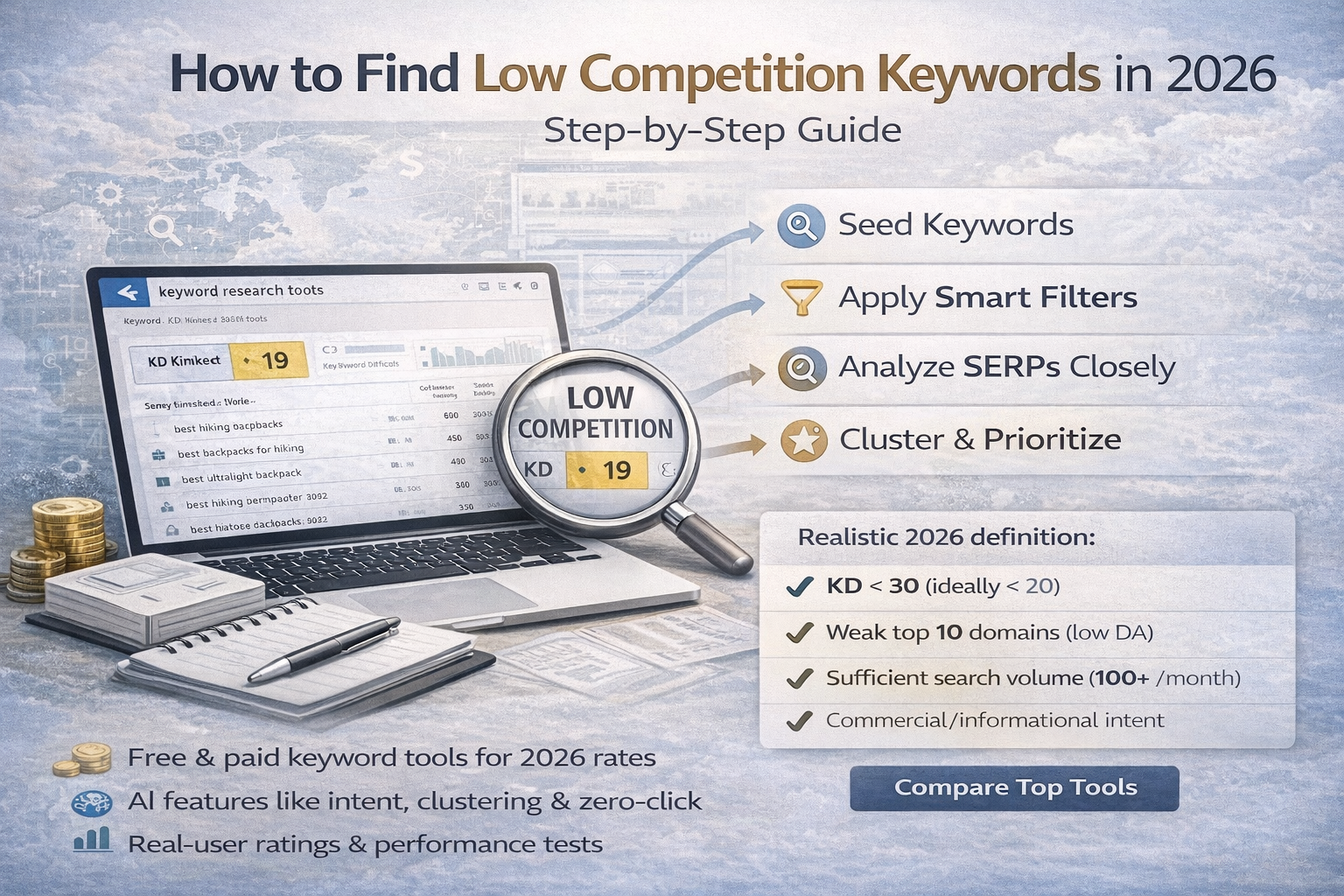
Realistic 2026 low-competition definition:
- KD ≤ 30 (ideally ≤ 20)
- Top 10 results include weak domains (low DA < 40, thin content, poor UX)
- No heavy SERP features (or features you can realistically win)
- Search volume ≥ 100–300/month (enough to drive meaningful traffic)
- Commercial/transactional intent (or informational that leads to conversion)
Step-by-Step Guide: How to Find Low Competition Keywords 2026
Step 1: Choose Your Primary Keyword Research Tool (2026 Recommendations)
Pick one main tool — mixing free + paid gives the best results.
Recommended 2026 Stack:
| Budget Level | Primary Tool | Secondary / Free Tools | Monthly Cost (approx.) |
|---|---|---|---|
| Beginner / $0–$30 | Keywords Everywhere + Google Keyword Planner | Google Trends, AlsoAsked free, AnswerThePublic free | $0–$10 (lifetime ext.) |
| Intermediate / $30–$100 | KWFinder (Mangools) Premium | AlsoAsked Pro, Google Search Console | $30–$50 |
| Pro / $100–$300 | Semrush Guru or Ahrefs Standard | AlsoAsked + Keywords Everywhere | $130–$250 |
| Enterprise / $300+ | Semrush Business + Ahrefs Enterprise | Custom AI scripts + internal data | $400–$1,500+ |
Step 2: Brainstorm Seed Keywords (5–10 Minutes)
Start broad — list 10–20 seed keywords related to your niche.
Examples (2026 niches):
- “keto meal prep”
- “best wireless earbuds 2026”
- “how to start dropshipping”
- “solar panel installation cost”
- “AI writing tools”
Pro tip 2026: Include year-specific modifiers (“2026”, “best in 2026”) — they often have lower competition but rising volume.
Step 3: Expand with Keyword Suggestions (Core Discovery Phase)
Use your primary tool to generate 500–5,000 suggestions.
Filters to apply immediately (critical for low competition):
- Keyword Difficulty (KD): ≤ 30 (ideally ≤ 20)
- Search Volume: ≥ 100–300/month (avoid <50 unless hyper-niche)
- Word Count: 3+ words (long-tail = lower competition)
- Include Questions: “how to”, “best”, “vs”, “review”, “guide.”
- Exclude branded terms (unless you own the brand)
Tool-specific tips:
- Semrush Keyword Magic Tool: Use “Intent” filter → focus on Commercial Investigation & Transactional
- Ahrefs Keywords Explorer: Sort by “KD” ascending + “Traffic Potential” descending
- KWFinder: Use “SERP Features” filter — look for keywords where top results have no featured snippet or weak domains
Step 4: Analyze SERP Quality (The Most Important 2026 Step)
Open the top 10 results for each promising keyword and score them:
Quick SERP Quality Checklist (2026):
- Are top 3 results high-DA sites (DA 60+)? → High competition
- Is there an AI Overview / featured snippet? → Harder to win unless you can outrank it
- Are results thin content / forum posts / outdated articles? → Golden opportunity
- Do results have poor UX (slow load, bad mobile, intrusive ads)? → You can beat them
- Are there video carousels or image packs? → Video content may be required
2026 red flags for “easy” keywords:
- Missing: Weak domains, Reddit/Quora/forum answers, outdated 2023–2024 articles
- Present: High-authority sites, perfect on-page, massive backlinks, video carousels
Step 5: Cluster & Prioritize Keywords
Group similar keywords into topic clusters — Google loves topical authority in 2026.
Manual clustering method (free):
- Export 200–500 keywords from your tool
- Sort by parent topic (use “contains” filter: “keto”, “dropshipping”, etc.)
- Create pillar page + 5–10 supporting articles per cluster
Automated clustering:
- Semrush Topic Research
- Ahrefs Content Explorer → “Parent topic” column
- AlsoAsked + manual grouping
Prioritization framework 2026 (score each keyword 1–10):
- KD ≤ 20: +3 points
- Volume 300–1,000/mo: +2 points
- Commercial/transactional intent: +3 points
- Weak SERP (low DA, no snippet): +4 points
- You can realistically create better content: +3 points
Target score ≥ 10 = strong candidate
Step 6: Validate & Test (Avoid Wasting Time)
Before writing:
- Check search intent manually (read top 5 results)
- Use Google Search Console (if you have data) → see current impressions/clicks
- Run small content tests (publish 3–5 articles → track 30–60 days)
- Use AlsoAsked to confirm question depth
Step 7: Scale & Monitor in 2026
- Track rankings weekly (Semrush Position Tracking / Ahrefs Rank Tracker)
- Monitor SERP changes (AI Overviews can steal clicks)
- Refresh old content every 6–12 months
- Build topical clusters → aim for 20–50 keywords per pillar
Common Mistakes When Hunting Low-Competition Keywords in 2026
- Relying only on KD score (ignore SERP quality)
- Targeting zero-volume keywords (no traffic even if #1)
- Ignoring intent (writing informational for commercial queries)
- Not checking mobile SERP (different features)
- Skipping AI Overview analysis (huge click loss potential)
Real 2026 Case Studies (Low-Competition Wins)
Case 1 – Niche Blog (Health Supplements) Seed: “best magnesium supplement” Found: “magnesium glycinate vs citrate 2026” KD 18, volume 450/mo SERP: Mostly 2023–2024 articles + forums Result: #3 in 45 days → 380 monthly clicks
Case 2 – E-commerce Store (Outdoor Gear) Seed: “best hiking backpack” Found: “ultralight backpack under 2 lbs 2026” KD 12, volume 280/mo SERP: Weak product pages + old reviews Result: #1 in 60 days → 12% conversion rate
Case 3 – SaaS Landing Page Seed: “project management software” Found: “best project management tool for freelancers 2026” KD 22, volume 620/mo SERP: Outdated lists + Reddit threads Result: #4 in 75 days → 210 sign-ups
Final Thoughts
Finding low-competition keywords in 2026 is easier than ever — thanks to better tools, AI intent signals, and SERP transparency — but it requires combining data with real SERP analysis.
Follow this step-by-step process consistently and you’ll uncover hundreds of profitable keywords that most people miss.
Ready to turn low-competition keywords into high-converting content and websites? Progriso helps businesses build SEO strategies that rank fast and sustainably.
- Get your free keyword & competitor audit: https://progriso.com/book-a-free-discovery-call/
- Explore our SEO & content services: https://progriso.com/seo-services/
- View real project results: https://progriso.com/portfolio/
- Contact us directly: https://progriso.com/contact/
Let’s find keywords that actually grow your business in 2026.