
Shopify vs Custom Ecommerce Website 2026: The Ultimate Ecommerce Platform Comparison
Shopify vs custom 2026 is the most important decision online store owners are making right now. In 2026, choosing between Shopify’s easy all-in-one platform and a fully custom-built ecommerce website will directly determine your long-term revenue, SEO rankings, customer experience, profit margins, and how much control you keep over your business.
Shopify has become extremely popular because it lets almost anyone launch a professional-looking store in days with almost no technical skills. But more and more successful brands are discovering that custom ecommerce websites (built on WordPress/WooCommerce, headless commerce, or other modern frameworks) deliver far better performance, complete ownership, zero transaction fees, unlimited customization, stronger SEO, and dramatically lower long-term costs.
In this ultimate 2026 comparison, we break down every major factor head-to-head so you can decide which platform is truly better for your business in today’s competitive landscape:
- Real pricing (monthly vs one-time costs)
- Features & functionality comparison
- SEO performance in 2026
- Speed & Core Web Vitals
- Scalability limits
- Ownership & vendor lock-in
- Customization & branding control
- Transaction fees & hidden costs
- Maintenance & support
- Real user experiences and case studies from 2026
By the end, you’ll know exactly whether Shopify or a custom ecommerce website is the right choice for your store in 2026.
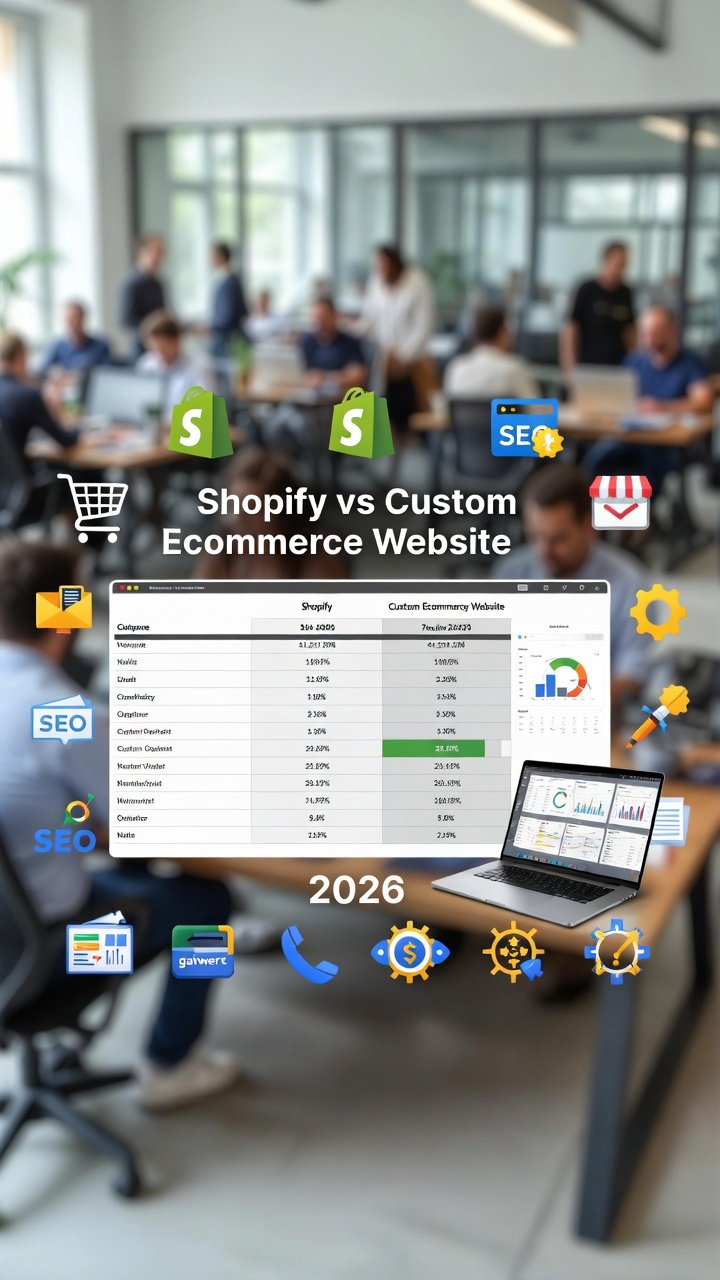
Shopify vs Custom Ecommerce – Quick 2026 Comparison Table
| Factor | Shopify | Custom Ecommerce Website | Winner in 2026 |
|---|---|---|---|
| Starting Cost | $29 – $299/month + apps | $3,500 – $15,000+ one-time | Shopify (lower entry) |
| Full Code & Data Ownership | No (you rent the platform) | Yes (you own everything) | Custom |
| Customization Level | Limited (themes + apps) | Unlimited | Custom |
| Performance & Speed | Good (shared infrastructure) | Excellent (fully optimized) | Custom |
| SEO Control | Good | Full control | Custom |
| Transaction Fees | 0.5% – 2% (if not using Shopify Payments) | 0% | Custom |
| Scalability | Very good (up to millions in sales) | Unlimited | Tie |
| Ease of Use | Extremely easy | Requires developer/agency | Shopify |
| Long-term Monthly Cost | $29 – $299 + apps + transaction fees | $20 – $150 (hosting + maintenance) | Custom (cheaper long-term) |
Detailed Pricing Breakdown – Shopify vs Custom 2026
Shopify Pricing in 2026 Shopify offers four main plans. The Basic plan starts at $29 per month, the Shopify plan at $79, Advanced at $299, and Shopify Plus (for very large stores) begins at $2,300 per month. You also pay extra for apps, themes, and transaction fees (0.5%–2%) unless you use Shopify Payments.
Custom Ecommerce Pricing in 2026 A small starter store typically costs $3,500–$6,000 one-time. A medium store with 500+ products ranges from $6,000–$12,000. Large or highly complex stores (custom checkout, advanced filtering, loyalty programs) usually fall between $12,000 and $25,000+. Monthly maintenance and hosting usually cost $50–$200.
After 18–24 months, a custom-built store is almost always cheaper because you eliminate Shopify’s recurring platform fees and transaction charges.
Features & Functionality – Head-to-Head in 2026
Shopify Strengths Shopify provides over 8,000 apps and integrations, built-in checkout, payments, inventory, taxes, shipping, excellent abandoned cart recovery, multi-currency and multi-language support, and very fast setup.
Custom Ecommerce Strengths Custom ecommerce gives you completely unique design and user experience, advanced product filtering, custom checkout flows, better performance and loading speed, full data ownership, no transaction fees, and easier integration with any third-party tool.
SEO Performance – Shopify vs Custom in 2026
Shopify SEO Shopify offers good out-of-the-box SEO, but you have limited control over technical SEO elements such as URL structure, schema markup, and Core Web Vitals.
Custom Ecommerce SEO With a custom ecommerce website you have full control over everything: URL structure, schema markup, internal linking, speed, mobile optimization, and advanced Product, FAQ, Breadcrumb, and Organization schema.
Winner in 2026: Custom ecommerce (especially in competitive niches). Source: Google Search Central – Technical SEO guidelines
Speed & Core Web Vitals – 2026 Reality
Shopify sites typically load in 2–4 seconds. Custom-built sites can consistently load in under 1.5 seconds with proper optimization.
In 2026, Google’s Core Web Vitals are stricter than ever. Faster sites get better rankings and higher conversion rates. Source: Google Developers – Core Web Vitals
Winner: Custom ecommerce
Scalability – Can It Grow With Your Business?
Both platforms can scale to millions in sales, but custom solutions give you unlimited scalability without monthly platform fees.
Winner: Tie (both are strong)
Ownership & Control – Who Really Owns Your Store?
With Shopify, you are renting the platform. With custom ecommerce, you own the code, database, design, and all customer data.
Winner: Custom ecommerce
When to Choose Shopify in 2026
Choose Shopify if:
- You want to launch very quickly (days, not weeks)
- You have limited technical knowledge or budget
- You sell standard products (fashion, electronics, beauty, etc.)
- You prefer a simple dashboard and 8,000+ apps
When to Choose Custom Ecommerce in 2026
Choose Custom if:
- You need unique features or branding
- You want maximum performance & SEO control
- You plan to scale big (7-figure+ revenue)
- You want full data ownership and no transaction fees
- You want long-term cost savings
Final Verdict – Shopify vs Custom 2026
Shopify wins if you want speed, ease of use, and lower upfront cost.
Custom ecommerce wins if you want better performance, stronger SEO, full control, no transaction fees, and long-term scalability.
For most growing businesses in 2026, a custom-built ecommerce website (especially on WordPress/WooCommerce or headless architecture) delivers the best long-term results.
If you’re ready to build a high-performing ecommerce store that ranks well, converts customers, and scales with your business — Progriso is here to help.
You can:
- Book a free 30-minute discovery call to discuss your ecommerce project: https://progriso.com/book-a-free-discovery-call/
- See our recent ecommerce examples
- Get a transparent fixed-price quote with no hidden fees
- Contact us directly: https://progriso.com/contact/
Let’s build an online store that actually grows your business.