
Website Cost 2026: How Much Does a Website Cost? Real Prices & Breakdown
Website cost 2026 is one of the first things every business owner searches for when planning to get online. In 2026, your website is your 24/7 salesperson, portfolio, lead generator, and often your primary sales channel — so understanding real pricing is essential.
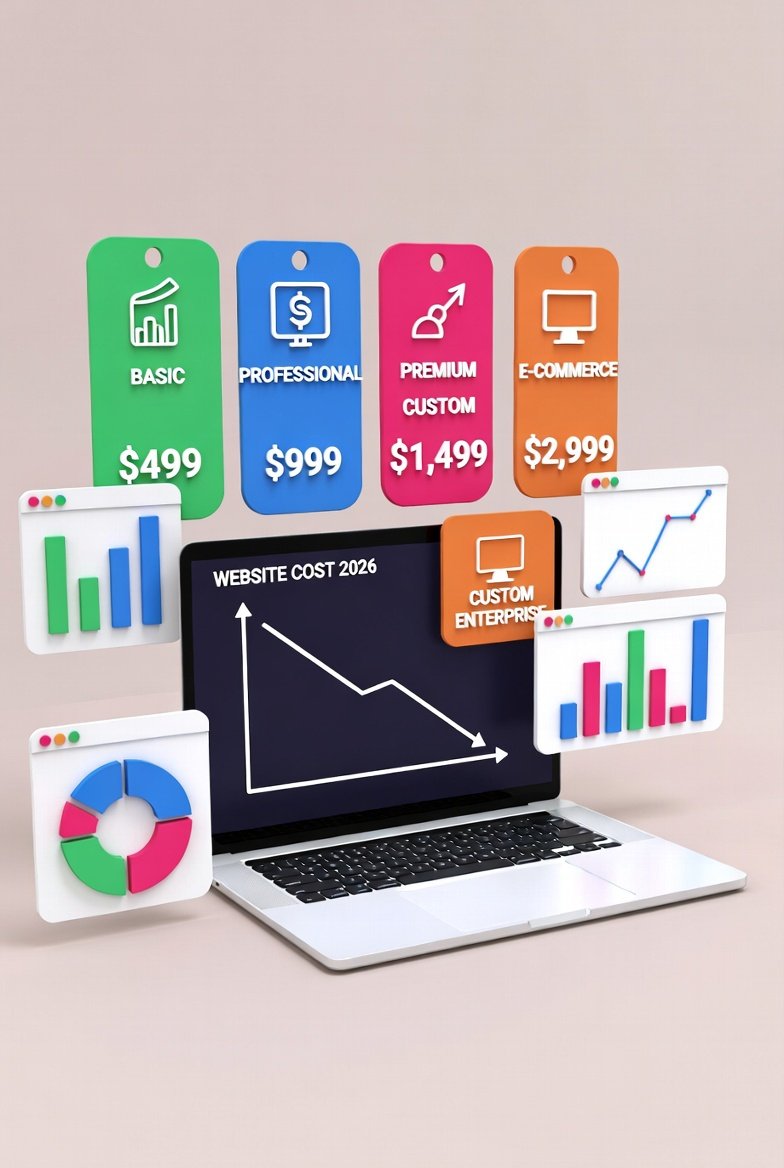
Prices range from $200 for a basic starter site to $40,000+ for advanced custom web applications. Most small and medium businesses spend between $800 and $8,000 for a professional, fast, mobile-friendly website that drives real customers.
This extremely detailed guide explains everything about website cost 2026: real price ranges for every common website type, what features and quality you get at each budget level, all the factors that increase or decrease website cost, hidden fees, how to choose the perfect budget, common mistakes, and tips to get maximum value.
Let’s break it down step by step so you can make an informed decision.
Current Website Price Ranges in 2026
Website cost 2026 varies greatly depending on the type of site, number of pages, features, design complexity, and technical requirements. Below are realistic 2026 price ranges based on thousands of real projects delivered worldwide.
1. Basic One-Page or Landing Page Websites
Price Range: $200 – $800 Typical Timeline: 3–10 days
This is the most affordable option and perfect for freelancers, consultants, coaches, local service providers, or anyone who needs a single high-converting page to capture leads or promote a service.
Lower-budget options ($200–$400) usually use simple templates with a headline, text, images, and a contact form. They launch quickly and work well for testing ideas or establishing a fast online presence.
Higher-budget landing pages ($500–$800) include better mobile optimization, faster loading, custom brand colors, lead forms integrated with email tools, and sometimes basic animations or testimonials.
Comparison Table – Basic Landing Pages
| Budget Level | Price (USD) | Features Included | Best For |
|---|---|---|---|
| Entry | $200–$400 | Template, basic text, contact form | Quick launch, testing an idea |
| Mid | $400–$600 | Custom colors, mobile optimization, forms | Freelancers, local services |
| Upper | $600–$800 | Faster load, lead capture, basic SEO | Lead generation, promotions |
2. Simple Multi-Page Business Websites
Price Range: $900 – $2,800 Typical Timeline: 2–5 weeks
This is the most popular category for small and medium businesses that want more than one page but don’t need ecommerce or complex custom features.
You typically get 5 to 12 pages: Home, About, Services/Products, Contact, Gallery/Portfolio, Blog/News (optional), Testimonials or FAQ.
At this level you receive a clean modern design, fast loading speed, full mobile responsiveness, basic SEO setup, contact forms, Google Maps, social links, and easy content editing.
Comparison Table – Website Cost 2026 – Multi-Page Business Sites
| Budget Level | Price (USD) | Pages | Key Features | Best For |
|---|---|---|---|---|
| Entry | $900–$1,400 | 5–7 pages | Basic design, mobile, contact form | Small local businesses |
| Mid | $1,400–$2,000 | 8–10 pages | Custom design, basic SEO, gallery | Consultants, coaches |
| Upper | $2,000–$2,800 | 10–12 pages | Advanced SEO, testimonials, blog | Service businesses |
3. Professional WordPress Websites
Price Range: $2,200 – $6,500 Typical Timeline: 4–8 weeks
WordPress powers around 43% of all websites on the internet in 2026 because it is flexible, scalable, and easy to grow over time.
At this level you get 15–30 custom pages, advanced SEO, a blog/news section, lead forms, galleries, testimonials, video embeds, integrations with email marketing and calendars, speed optimization, and strong security features.
Comparison Table – Professional WordPress Sites
| Budget Level | Price (USD) | Pages | Key Features | Best For |
|---|---|---|---|---|
| Entry | $2,200–$3,500 | 15–20 pages | Custom design, blog, basic SEO | Growing small businesses |
| Mid | $3,500–$5,000 | 20–25 pages | Advanced SEO, integrations, speed | Service companies, blogs |
| Upper | $5,000–$6,500 | 25–30 pages | Full optimization, CRM/email, security | Professional brands |
4. Full Ecommerce Online Stores
Price Range: $3,500 – $12,000 Typical Timeline: 6–12 weeks
If you sell physical products, digital downloads, or services online, an ecommerce store is essential.
Typical features include product catalog with categories & filters, secure shopping cart & checkout, multiple payment gateways, inventory management, shipping/tax rules, mobile-first shopping experience, and abandoned cart recovery. Many stores use WooCommerce, the most popular ecommerce plugin for WordPress .
Comparison Table – Ecommerce Stores
| Budget Level | Price (USD) | Products | Key Features | Best For |
|---|---|---|---|---|
| Entry | $3,500–$6,000 | Up to 100 | Basic catalog, payments, mobile | Small online shops |
| Mid | $6,000–$9,000 | 100–500 | Filters, abandoned cart, SEO | Growing ecommerce |
| Upper | $9,000–$12,000 | 500+ | Loyalty, custom flows, inventory | Serious online retailers |
5. Custom Web Applications & SaaS Platforms
Price Range: $10,000 – $40,000+ Typical Timeline: 10–20+ weeks
These are advanced solutions beyond traditional websites (booking systems, membership portals, dashboards, SaaS products).
They require databases, user authentication, custom logic, API integrations, and scalability planning. Popular frameworks in 2026 include React for front-end .
Comparison Table – Website Cost 2026 – Custom Applications
| Budget Level | Price (USD) | Complexity | Key Features | Best For |
|---|---|---|---|---|
| Entry | $10,000–$18,000 | Medium | Basic login, database, simple dashboard | Small SaaS or tools |
| Mid | $18,000–$28,000 | High | Advanced logic, API, payments | Medium SaaS, booking systems |
| Upper | $28,000–$40,000+ | Very High | Scalability, security, custom UI | Enterprise-level applications |
What Drives Website Cost Up or Down in 2026?
The final price is influenced by many factors. Here are the most important ones with detailed explanations:
Design & Customization Level A site built entirely from a pre-made template costs far less than one with unique layouts, custom illustrations, animations, or brand-specific visuals.
Number of Pages & Sections Each additional page or complex section adds development time and cost.
Ecommerce & Payment Systems Adding a shopping cart, secure checkout, inventory management, shipping rules, multiple payment methods, and abandoned cart recovery significantly increases development effort.
SEO & Technical Performance Higher budgets include Core Web Vitals compliance , image optimization, lazy loading, schema markup, clean code structure, and mobile-first indexing.
Integrations & Third-Party Tools Connecting to CRM, email marketing, calendars, payment gateways, analytics, or custom APIs adds complexity and cost.
Content Creation Professional copywriting, high-resolution photography, custom icons, illustrations, videos, and graphic design elements cost extra.
Developer Experience & Location Experienced developers charge more but deliver better quality, fewer bugs, and faster long-term performance.
Timeline & Urgency Rush projects often cost 20–50% more due to priority scheduling.
Ongoing Support & Maintenance Monthly plans for updates, security, backups, and content changes add recurring costs.
Hidden or Unexpected Costs to Watch For
Many buyers focus only on the initial build price, but these extras can add up quickly:
Premium Plugins & Themes Many WordPress sites rely on paid tools for forms, SEO, security, sliders, popups ($50–$800/year).
Professional Photography & Copywriting High-quality images and well-written text improve trust and conversions ($300–$3,000).
Fast & Reliable Hosting Good hosting that keeps your site fast and secure costs $10–$100/month.
SSL Certificate & Security Advanced security (firewall, malware scanning) adds $50–$300/year.
Regular Updates & Backups Keeping everything updated and backed up costs $50–$200/month.
Marketing After Launch SEO, Google Ads, social media ads, email campaigns — these drive traffic but require budget.
How to Choose the Right Budget for Your Business
Before getting quotes, ask yourself these questions:
- What is my main goal? (leads, sales, brand awareness, bookings)
- How many products/services do I offer?
- Do I need to accept online payments?
- How important is custom design and branding?
- Do I want to rank well on Google and attract free traffic?
- Will I update content myself or need ongoing help?
- How soon do I need the site live?
- What is my realistic budget range?
Answering these honestly will help you avoid buying too little or too much.
Cheap vs Professional Website — The Real Difference – Website Cost 2026
A very low-cost website ($200–$500) can get you online quickly, but it often comes with trade-offs: very basic design, slower loading, poor mobile experience, weak SEO foundation, limited features, and little or no support.
A professional website ($900+) usually delivers: custom or highly customized design, fast loading, excellent mobile responsiveness, strong SEO foundation, better conversion rates, long-term scalability, and reliable support after launch.
In most cases, the extra investment pays for itself many times over through more customers, higher trust, and fewer future fixes.
Final Thoughts
Website cost 2026 depends on your goals, features, quality, and long-term plans. Whether you start with a $200 simple landing page or invest $5,000+ in a full ecommerce platform, the key is to match the site to your actual business needs.
If you’re ready to get a clear, honest quote for your project — no matter your budget — Progriso is here to help small businesses and growing companies get online and succeed.
You can:
- Book a free 30-minute discovery call to talk through your project: https://progriso.com/book-a-free-discovery-call/
- See our recent example websites
- Get a transparent fixed-price quote with no hidden fees
- Contact us directly to discuss your needs: https://progriso.com/contact/
Let’s build something that brings you real customers and growth.